
Scalp cooling offers comfort and confidence
Key Takeaways:
- Scalp cooling technology is now offered at all OSF cancer center locations
- Scalp cooling can help prevent hair loss in chemotherapy patients
- New equipment was donated by Patricia Cutilletta
- Scalp cooling can benefit patients' self-esteem and confidence
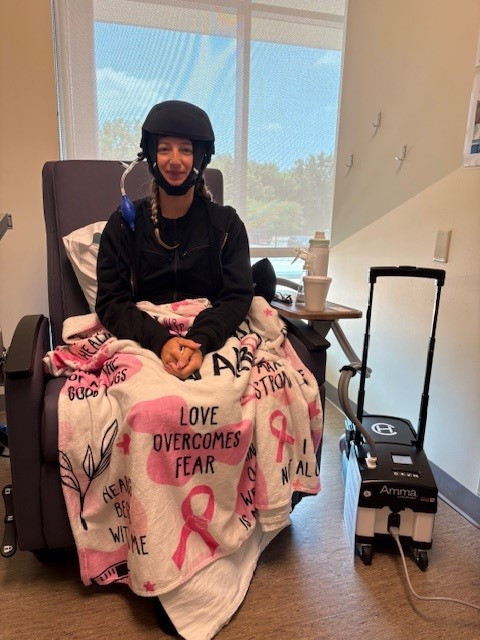
“My world was turned upside down.”
These are the words of 36-year-old Amanda Wlezen, from Poplar Grove, Illinois, who just found out she has a Stage 1 breast cancer known as invasive ductal carcinoma.
"Being so young, it was something I was not expecting. I honestly went in and thought I would get a full clean bill of health, like 'you're good to go,' but that was not the case," Wlezen says.
Aside from battling the disease, Wlezen is now also faced with another challenge. The potential of hair loss.
"(Your hair is) your identity. It's how you approach people and feel confident,” Wlezen adds.
Thanks to a generous donation by breast cancer survivor Patricia Cutilletta, chemotherapy patients now have an extra tool to help keep their hair during treatment. It’s known as scalp cooling and is offered across the OSF HealthCare Ministry at all six OSF cancer centers.
“The cooling cap can give you your confidence back, so I feel like that's going to help others," Wlezen says.
Scalp cooling allows the patient’s temperature to be brought down to 65 degrees Fahrenheit, which then reduces the amount of chemo that is absorbed by hair follicles. This, in turn, helps decrease the amount of hair loss. A cooling cap is used and personalized for the individual patient. It’s fitted to their head and is not reused.
While scalp cooling has been around for some time, the new equipment is much more user-friendly and accessible.
"The old machines are very large and cumbersome. You had to have someone bring dry ice. You almost had to have another person with you to make that successful," says Leah Goforth, manager of gynecological oncology at OSF HealthCare Cancer Institute in Peoria, Illinois. "This company we've partnered with, and the new designs, have made it more accessible and portable.”
Wlezen says this opportunity has given her a lot of reassurance during a difficult time.
"I honestly thought I was going to lose all my hair and that I didn't have an option. So, I am very grateful for this innovative product, and for giving it a shot and helping me to maintain these beautiful locks," Wlezen laughs.
This is a real challenge seen in many patients, says Julie Cline, manager of oncology services at OSF HealthCare Saint Anthony Medical Center in Rockford, Illinois.
"We have had some patients in the past ask if we were able to offer this, and we, at that time, were not. We have had some patients bring in their own supplies, which is way more costly for them to do,” Cline says. “So, this provides them with a tool to help lessen their anxiety and protect their self-image."
Michelle Rowland, MD, is a gynecologic oncologist at OSF Cancer Institute. She says scalp cooling can offer several benefits for the patient.
"It is important for the patient in terms of self-esteem and being able to continue doing things like their job, that they don't have to explain to everyone why their hair is falling out," Dr. Rowland says. "For some people, it's a level of comfort and confidence that they can carry through chemotherapy. That overall, I think, helps them tolerate it better."
Dr. Rowland says not all chemotherapy treatments cause hair loss, so it’s important for the patient and doctor to discuss if scalp cooling is the right option.
"For some of our treatments, it might only be effective for 30% of patients. For others, it might be much higher at 80%," Dr. Rowland says.
Aside from the emotional and mental benefit scalp cooling can provide, there can also be a physical benefit, Dr. Rowland adds.
"Losing your hair, oftentimes, is irritating to the scalp. We do have patients that have complications of losing their hair. It's not as simple as 'my hair fell out,' but you may have folliculitis (infection) across the scalp," Dr. Rowland says. "Keeping the scalp healthy and doing things for the scalp can help them avoid some of those complications."
Goforth says during a time when you feel like you don’t have much control, this technology changes that.
"It's that sense of empowerment,” Goforth agrees. “That was one of the big things that Pat (Cutilletta) has been very vocal about. It's not about vanity; it's about empowerment back to the patient during a very powerless-feeling time in their journey.”
Cline says her greatest satisfaction is giving the patients some power over their cancer.
"Patients come in here all the time, very teary eyed, very sad, because they have no control. They feel like cancer is controlling their life, so this just gives them that hope of having something that I can control. It helps lessen that anxiety, sometimes even helps them stay on their treatment plan and stay compliant with it,” Cline says.
Cline explains that the scalp cooling process starts 30 minutes before chemotherapy infusions. It then continues through the end of the treatment, and then depending on the treatment regimen, continues another two to three hours post treatment cooling.
Oftentimes the scalp cooling service is covered by insurance. The patient’s care team should submit the treatment to insurance before the scalp cooling service starts to get an idea of how much insurance will cover. The patient would then find out what if there is going to be any out of pocket costs.
If you’re in need of cancer support services and need help finding an appointment or a provider, visit the OSF HealthCare website.