
An OSF inventor collaborates to help kids play safely through cancer
Key Takeaways:
- Exercise physiologist Nick Kemp collaborated with OSF Innovation Studio to design Port Guard that protects the central venous access port for pediatric cancer patients who want to stay active.
- PortGuard fosters a sense of normalcy and inclusion while ensuring patient safety.
- Seven-year-old Amaneigh Stevenson, pediatric cancer patient, was part of testing and declared, “It makes me feel safe. I love it a lot.”
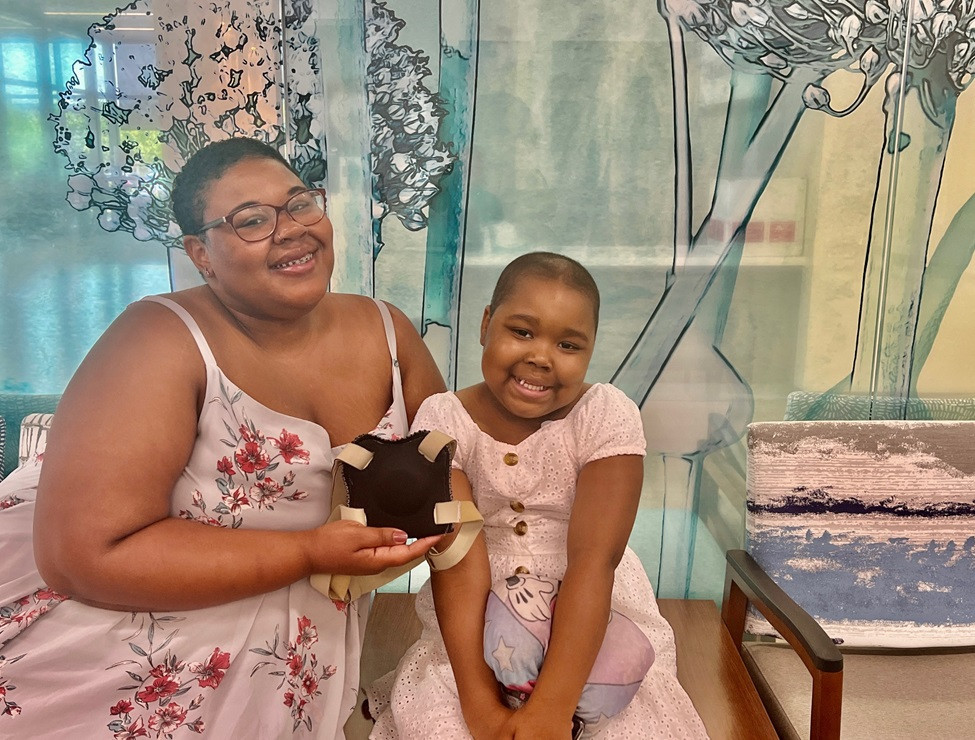
Amaneigh (pronounced uh-MAHN-ee) Stevenson of Bloomington, Illinois, is a sassy 7-year-old girl who until January had never undergone surgery or even had a broken bone. But that month she was diagnosed with Stage 3 Hodgkin lymphoma following a biopsy the previous month. Amaneigh is currently undergoing IV chemotherapy treatment at OSF HealthCare Children's Hospital of Illinois in Peoria. Her treatment is expected to last six months.
Having cancer has been a difficult challenge for the girl who embraces challenges, her mom, Karisma Morris-Bush, says. This was not a challenge her daughter was prepared for as Amaneigh has always been full of energy.
“Ever since she was a little girl, she’s been very active. She’s in gymnastics, she’s done cheerleading, she likes to play outside, run around, cartwheels, flips, you name it. Since she was a baby, she’s been climbing on everything.”
Before January, Amaneigh had never missed a gymnastics practice. But the middle child with three brothers was sidelined from that activity for her safety after having a central venous port implanted to deliver chemotherapy and other medications directly to the bloodstream. The port makes treatment safer and more comfortable for frequent infusions or blood draws.
Concerned about protecting the port, Morris-Bush worried about her daughter riding a bike or playing with friends. That’s when Nick Kemp, an exercise physiologist with OSF Children's Hospital of Illinois, told her about PortGuard, a device he was working on designing with OSF Innovation Studio engineers that prevents damage to a port during contact activities.
“She has lots of friends who are also very active, and there were incidents in which she was bumped into. I was concerned about maybe it [the port] might be dislodged or put her at some type of risk, and he [Nick Kemp] told me that he was creating this PortGuard. He gave me the entire plan. This is when it was in the beginning stages, and I told him I thought it sounds wonderful.”
Kemp says he outlined his ideas to the Innovation engineers and told them his solution needed to be durable and comfortable.
“It needed to be lightweight, kind of mobile, something that wouldn’t get in the way during sports – that they could wear it and not have any type of disadvantage during their sport, so I really wanted it to be as comfortable as possible.”
Bracing for impact
 OSF Innovation Studio engineer Reid Jockisch says they needed to create a divot in the design so that upon impact, the molded plastic would not contact the port that it was designed to protect. Jockisch explains engineers used a meter device to measure the force against the PortGuard as they hurled various size balls at high impact.
“We used balls from different sports – basketballs, baseballs. We threw them at the port to see and try to measure what kind of impact the port would have. That’s where the force gauge was. So, we measured what those numbers would be as compared to what it would be with no device, and we were able to get them to almost zero.”
That means the force on the port would be nearly zero with a high impact hit. Jockisch says they also tested the port’s durability and after pummeling it full force with a baseball bat, two-by-four and even a hammer, it was nearly indestructible.
The challenge, says Jockisch, was finding a balance between weight and comfort.
“We had to find lighter materials to encase the device such that when it gets attached with the supports, it’s able to stay in place. So, what’s been most helpful; there is patient feedback and their experiences wearing the device and what kind of activities were causing the device to shift around so we could design the straps in a way that supports the weight of the device.”
Morris-Bush was part of the prototype testing and says the design works, as she turns to Amaneigh and explains it.
“There is a spot right here. It’s kind of a circular spot, Amaneigh chimes in and says, “It goes over my port,” while mom adds, “Right, and that actually hugs the port and, in that spot, – and I can even put my hand over it – there’s space.” Amaneigh adds, “It’s like my port has gone into a mold.”
Morris-Bush says the hand washable PortGuard can even be used while her daughter is swimming. With lightweight straps connecting the guard in two places, it can be adjusted depending on the child’s size and what they’re wearing. Most of the time, Amaneigh puts it on by herself. She’s a big fan of the Port Guard because it put her back in action. Amaneigh even showed off a few of her gymnastics moves while wearing it.
“It makes me feel protected. It makes me feel safe. I don’t wear it often, but I wear it when I’m doing stuff I’m not supposed to do right now in this situation.” She adds, “It helps me, and I get to play with all the other kids. I love it a lot.”
For Kemp, that’s what his invention is all about. He’s excited that his idea to help pediatric cancer patients is doing just that.
“That’s the best part. It’s seeing the reactions and seeing them able to do activities and sports that they may not have felt as comfortable doing. So that’s the ultimate goal – to get them comfortable and bring them back to the normalcy that they were used to before treatment.”
The protective device is currently in use by 10 pediatric cancer patients. Kemp and OSF will be looking to collaborate with other children’s hospitals across the country to collect patient feedback. Once OSF Innovation Studio has collected additional feedback and has a final product, the goal is to make PortGuard available for as many kids as possible and ultimately scale production for wider use.