
Cancer survivor builds toy simulator to help kids prepare for MRIs
Key Takeaways:
- A cancer survivor helped create a toy MRI to reduce fear and anxiety for young patients facing a serious diagnosis.
- The hands-on simulator at OSF HealthCare Children's Hospital of Illinois lets children practice MRI scans using a stuffed animal or doll.
- Child life specialists hope the tool will remove anxiety and reduce the need to sedate young children who need imaging.
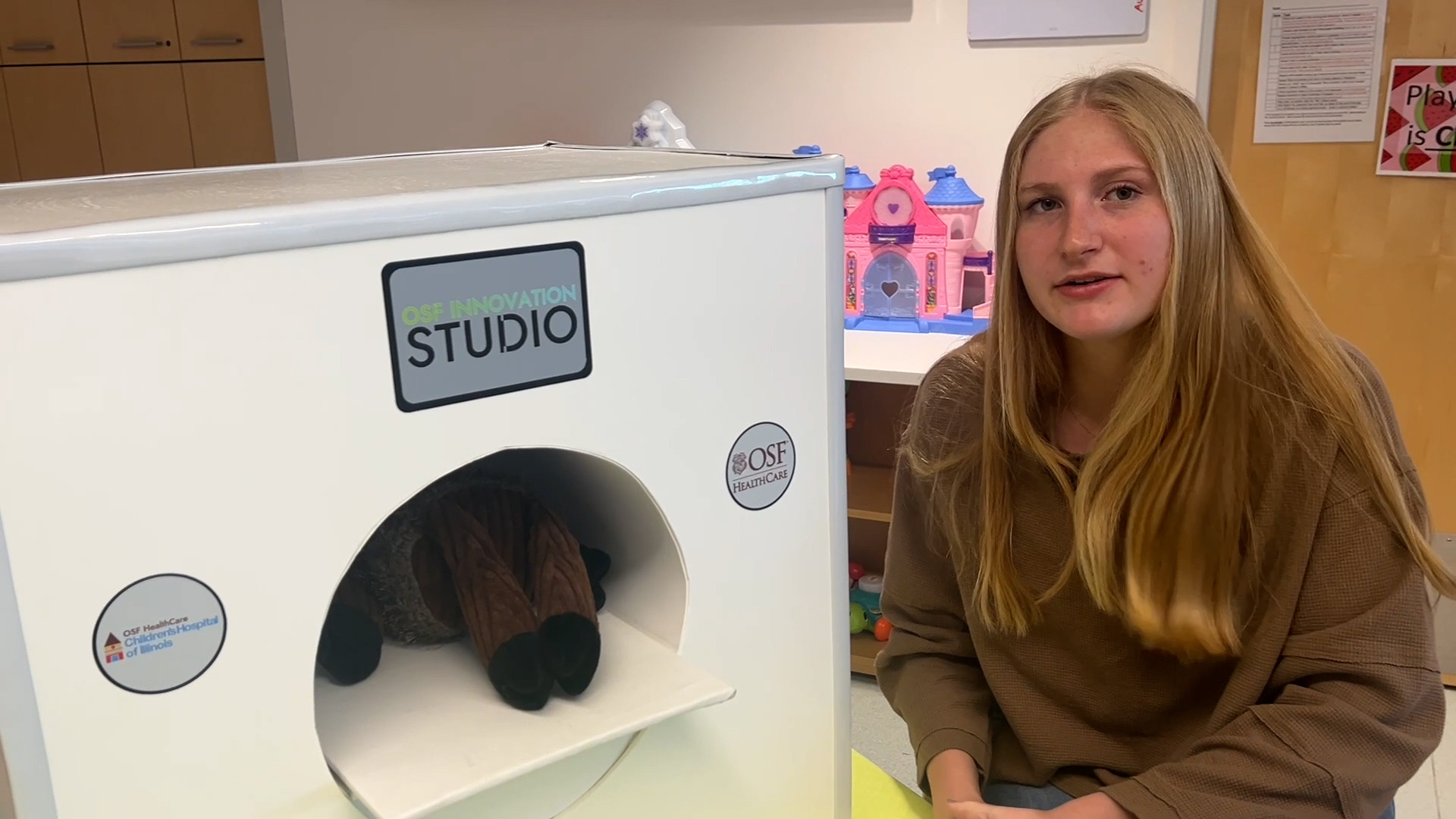
A new hands-on tool is helping young patients feel more prepared – and less afraid – before undergoing an MRI.
MRIs can be especially intimidating for children, who must lie still in a tight space surrounded by loud, unfamiliar sounds. Until now, child life specialists, like Allison West, at OSF HealthCare Children’s Hospital of Illinois in Peoria relied on educational materials to prepare patients. But West says many young children are hands-on learners.
“They need to be able to see, touch and manipulate. We had prep books and pictures and sounds that we would play for them, but we were missing something concrete,” says Child Life Specialist Allison West. “So, this was a huge need that Savannah was able to deliver for us.”
West is referencing former Tremont, Illinois, high school student Savannah Jost of Mapleton, whose interest in health care grew after her own serious cancer diagnosis.
Inspired by a cancer journey
In January of 2022, Jost was diagnosed with Hodgkin lymphoma. She went through eight rounds of chemo and 17 radiation treatments before doctors at OSF Children’s Hospital of Illinois declared her cancer free in December of 2022.
Jost then joined OSF HealthCare through a high school co-op program, where she helped design a simulated MRI with engineers from Jump Trading Simulation & Education Center. The idea was to help children role-play the experience using stuffed animals or dolls.
Sister M. Pieta Keller, F.S.G.M., an engineer with OSF Innovation Studio, part of the OSF Innovation ecosystem, explains there is a toy MRI available on the market, but it was prohibitively expensive. Instead, she and other engineers speculated that they could create something to simulate the medical imaging experience for kids, using their favorite toy as child life suggested.
“That could kind of show the child what happens and could we do it with a stuffed animal or doll or something that’s theirs – their object that’s special to them that could go through this, and they could see that everything was just fine and what would happen in that experience.”
Creating the MRI model for kids meant balancing realism with durability for young users Sister M. Pieta explains while discussing the creative process.
Design challenges
“As Savannah came to me with plans and ideas of what she wanted to do, we kind of went back through it. We let her do a first prototype of what she was thinking but then I was like we actually need to rebuild it and rebuild the inside so that it can withstand a small child climbing on top of it because,” Sister Pieta points out, “It is big enough to be a little gymnasium as well, so we wanted it to have that strength and robustness.”
West says children often have to have multiple imaging tests throughout their treatment and most of them have to be sedated. But the goal is to avoid having to put young children under anesthesia repeatedly.
“We think with additional education and preparation, that they (kids) would be able to do it successfully without that sedation,” West shares. “So, then we start prepping them. That’s where this beautiful machine comes in because we can use this to make them comfortable, to reduce that fear and really to prepare them for what to expect and kind of set them up for more success.”
The design and build process introduced Jost to the process of innovation. The biggest lesson she learned from engineers at Jump – you will most likely fail before you’re successful.
Lifelong lessons from engineers at Jump Simulation
“When I came in, they just answered all of my questions. They would help me, but they also let me try and fail and they would be like, ‘How would you do this?’ and I would go and do it and most likely fail and then they let me ask them and pick their brains about it. I just loved working with them.”
One of the biggest goals was to make the mini-MRI simulator as realistic as possible. From her own experience, Jost wanted to make sure there was no sugarcoating the experience. Combined with audio from a real MRI that can be played from a tablet, Jost thinks the team hit the mark.
The project represents more than just a design success. Jost stresses that it’s a way for her to pay it forward.
“It’s knowing that I get to give back to the community that helped me, that saved my life when I was 14 years old … just knowing that little kids here are using it and that I have the same cancer journey as some of them – It makes my 14-year-old self proud.” Jost is now a student at Bradley University, an OSF academic partner under its Innovation Academic Incubator. She eventually hopes to become a radiation oncologist.
Meanwhile, West says the simulated MRI has been used with a few patients and will be used with more in the future to help reduce fear, improve understanding and prepare children for real imaging exams – one stuffed animal at a time.