
The long run back
Key Takeaways:
- Brent Holcomb is a Genoa, Illinois, resident who competes in ultramarathons.
- In 2023, Holcomb started a 200-mile event until he fell ill and dropped out of the competition.
- For months, Holcomb struggled with his health, including breathing problems and dizziness.
- Finally, Holcomb was diagnosed with reactive airway disease (RAD), which mimics asthma.
- Two years later, Holcomb feels much better and has returned to running.
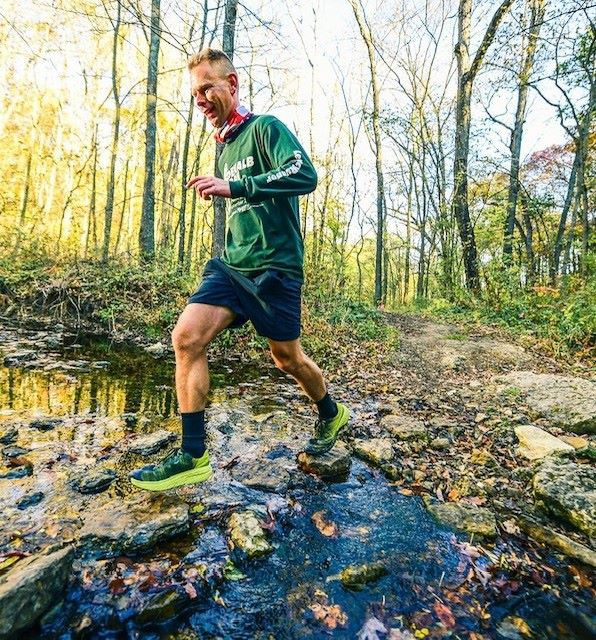
Brent Holcomb has plenty to be grateful for this Thanksgiving season. A wonderful family. A job he enjoys. And he’s back on his feet after a serious illness two years ago left the Genoa, Illinois, resident uncertain about his future.
The 39-year-old Holcomb is a physical therapy education coordinator for OSF HealthCare. He’s married and has five children which, he says, always keeps him moving. Fitting, since his favorite hobby is running.
Holcomb ran track in high school and college and eventually took to long distance running. Holcomb started out by competing in 5 and 10K races and then entered a marathon. Then he became hooked on ultramarathons, which is any race longer than the traditional marathon of 26.2 miles, which he’s been doing ever since.
“It's tough because, like a 5K or 10K you're working on faster running, but something like 100 miles, 200 miles, it ends up just being slower paced running, hiking a lot of hills,” he says. “So, it's a different type of training.”
While ultra-marathons are demanding, Holcomb never had any serious problem, until 2023. That’s when he competed in the Tahoe 200, a grueling four-day, 200-mile race around the largest alpine lake in the country, Lake Tahoe in Nevada. The 206.2-mile loop covers 36,857 feet of ascent and descent.
Holcomb was battling a head cold heading into the event. He thought nothing of it until a few miles into the race, he started to feel worse.
“During that first few miles I can’t smell, can’t taste, something doesn't seem right,” he recalls. “I continued for at least 85 miles and then started coughing up blood. I had to stop at that point.”
Holcomb thought he had COVID-19. He stayed in California for a few days to recover but continued to struggle with breathing and dizziness. He called his doctor as soon as he got home.
Depressed and scared
Over the next few months, Holcomb’s life became a whirlwind filled with doctor appointments, blood work and other medical tests. He says the tests still didn’t pinpoint the cause of his problems. Holcomb became depressed and scared. He went from a physically fit man who conquered 100-mile races to someone who couldn’t kick a soccer ball back to his young children without losing his breath.
“I felt like I was going to die,” he says. “I couldn't carry my daughter around, and she was a baby at that point. I couldn't walk upstairs from the parking lot. I was super short of breath, super dizzy. It was hard for me to do my job. I kind of just gritted through it.”
Holcomb was referred to Amith Jacob, MD, a pulmonologist with OSF HealthCare. Dr. Jacob ran a battery of tests on Holcomb. It took weeks, but finally Holcomb had the answers he was looking for.
He was diagnosed with reactive airway disease (RAD), which is like asthma. RAD occurs when your bronchial tubes, which bring air into your lungs, overreact to an irritation, swell and cause breathing problems. Certain conditions can cause RAD, including allergies, smoking, weather and exercise.
“What that means is anyone who has an infection, it can affect their airways, particularly their smaller airways, and can cause them to have what we describe as asthma-like symptoms or COPD-like symptoms,” says Dr. Jacob. “It makes them short of breath and causes them to have decreased functional tolerance. It can be associated with high heart rates when they are trying to do an activity that is strenuous, or even day-to-day activities. That was what was happening with Brent.”
Dr. Jacob started Holcomb on an intensive treatment plan that included medication, inhalers and several tests. It was a long road filled with good days and bad, Holcomb says, but about eight months after his troubles began on that long trail in Lake Tahoe, his health started to turn a corner. He could walk up a flight of stairs without trouble. And he began to return to running – one step at a time.
On the right path
Holcomb has returned to competitive running. He recently completed a 62-mile race, finishing in the top 25% of his age group.
“I was very happy to know that he was able to run an entire marathon,” says Dr. Jacob. “Because that shows not only that the medicines are doing what they should be, but that he remains motivated to get better and get back to living to his fullest capacity.”
Holcomb feels re-energized to be back in his environment – tackling tough terrain, testing his endurance and competing against other elite runners. He says he’s learned valuable lessons along the way about listening to his body and not overdoing it. At times he still feels short of breath, but says he’s most thankful to feel whole again.
“The main thing is I needed to be here for my family, and that became my priority,” he says. “So, if I never ran again, that was OK. But by the grace of God and Dr. Jacob, I was able to get back, and I have gotten better. And that's just a bonus at this point, that I have been able to get back to my hobby.”