
A message to men: Don’t wait to get checked
Key Takeaways:
- Don’t ignore urinary changes or other warning signs; getting checked can help catch prostate cancer earlier.
- Targeted radiation therapy can treat a tumor while limiting damage to surrounding tissue.
- Mark Segobiano encourages men not to assume they’re invincible and to make medical checkups a priority.
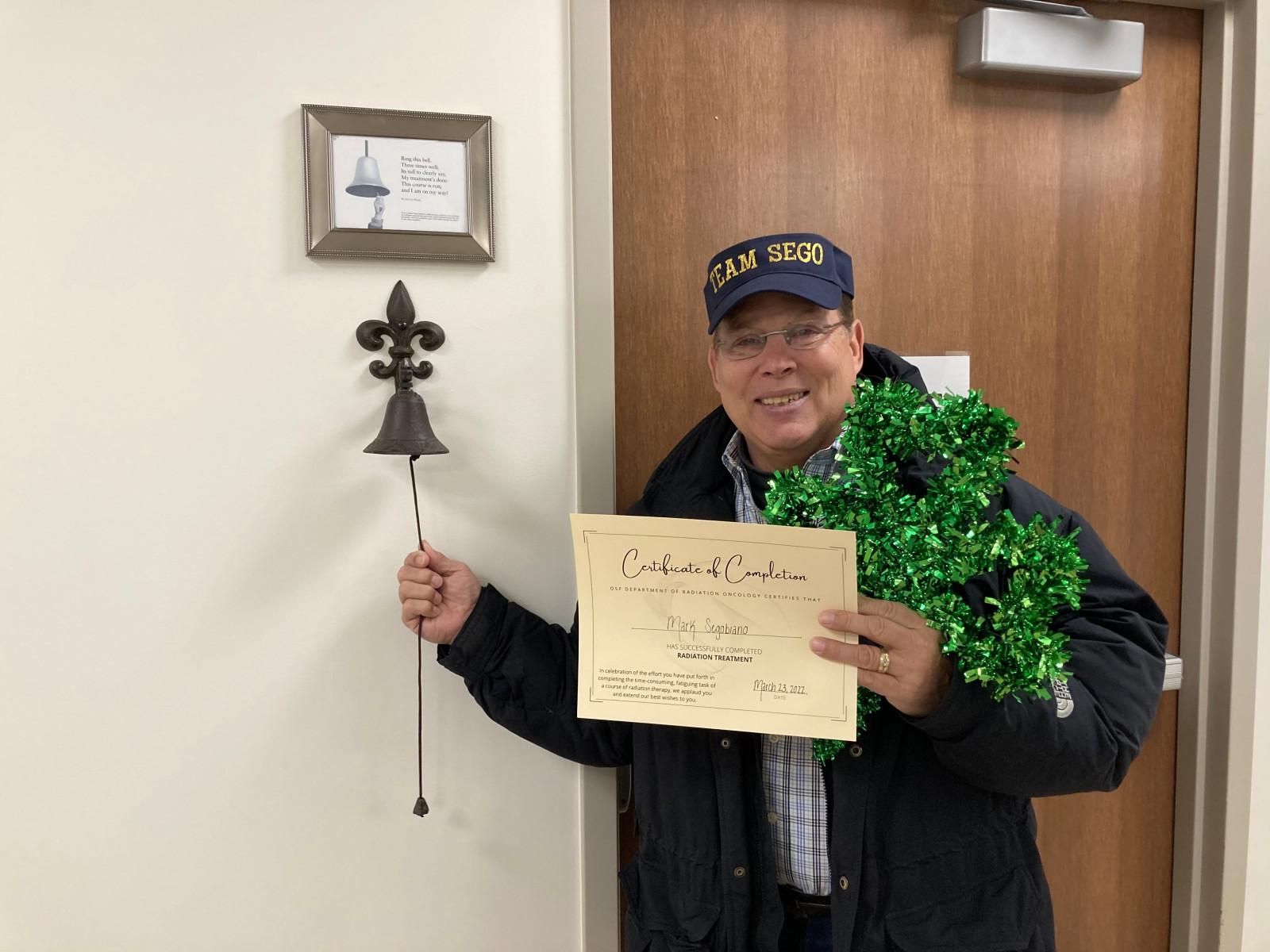
For Mark Segobiano, the hardest part of his prostate cancer journey came before treatment ever began.
It was hearing the word “cancer” again.
Mark had already battled acute promyelocytic leukemia years earlier, so when blood work and prostate testing revealed an elevated prostate-specific antigen (PSA) level, the news brought back familiar fears. He and his wife, Cindy, had learned firsthand how quickly a health concern could become something much more serious.
The Bloomington, Illinois, home inspector had been experiencing more frequent urination, particularly at night. Rather than dismiss the changes, he and Cindy decided to have them checked.
The testing led to a prostate cancer diagnosis in October of 2021, and because of the location of the tumor, surgery was not an option. Mark and Cindy’s hearts fell upon hearing that news.
Cindy Segobiano, however, says it was so comforting that within days, Mark had a treatment plan.
“We got to Dr. Gomez who referred us to Dr. Stang, and we had a plan immediately,” she remembers. “That to me was such a blessing that we had immediate attention and an immediate plan. The staff was so confident.”
Under the treatment from Kyle Stang, MD, a radiation-oncologist with OSF HealthCare, Mark underwent treatment using the advanced form of radiation known as modern intensity modulated radiation therapy (IMRT) with image guidance (IGRT). It is designed to precisely target a tumor while limiting exposure to surrounding tissue.
“It was a gamechanger for us to be able to be treated in our own hometown. I just remember that day we had such a comfort zone knowing that hey, ‘we got this.’”
 Mark underwent daily treatments for several weeks. The process required plenty of preparation, including drinking large amounts of water, but he says the care he received from the medical team at the OSF Cancer Center in Bloomington helped make an otherwise difficult experience more manageable.
“The staff over there was just unbelievable … so friendly, so warm and inviting. They made you feel very comfortable even though you were going through a process you really didn’t want to go through. I think that has a lot to do with your comfort zone as well – the staff around, and they were fantastic,” Mark recalls.
The treatment targeted the tumor without causing the kind of surrounding damage Mark had experienced with his earlier cancer treatment. When he was done with the targeted radiation, Mark returned for follow-up appointments and received encouraging results when in June of 2022, he was declared cancer-free.
His recovery was not without challenges. Fatigue was the biggest hurdle, and he took medication during the recovery period. But overall, he says the treatment itself was comfortable and his energy gradually returned.
On his final treatment day, the staff gathered to celebrate with him, ringing a bell and giving him a hat marking him as part of “Team Sego.”
For Mark, the experience reinforced the importance of paying attention to his health and encouraging other men to do the same.
His message to other men during this Prostate Cancer Awareness Month is straightforward: Don't assume you're invincible. It’s better to be proactive than reactive, especially when a simple blood test can provide preliminary results.
Don’t ignore symptoms
- Needing to pee more often or urgently, especially at night
- Trouble starting a urine stream or a weak and interrupted flow
- Feeling like the bladder is not completely empty
- Pain or burning during urination
Other signs
- Blood in the urine or semen
- Painful ejaculation or new or sudden erectile disfunction
- Deep pain or stiffness in the lower back, hips or pelvis that does not go away
Mark Segobiano acknowledges that men can sometimes be reluctant to seek medical care, particularly when symptoms seem minor or they otherwise feel healthy.
“Don’t be afraid to say, ‘Yeah, I need to go get checked out,’ whether it’s something small, because small things turn into big things and you don’t want them to get to that point,” says Mark. He adds, “I would highly suggest that if you're at a stage in your life, and we all know what stages those are, that you go ahead and get checked out.”
The experience has also changed Mark's perspective on everyday health. He is now more mindful of his body, medical appointments and the importance of staying proactive.
Most of all, he credits his family, his faith and the medical professionals who guided him through the diagnosis and treatment.
For Mark, cancer is not something that simply disappears from his thoughts after treatment ends. But neither is the gratitude he feels for having caught the disease, received treatment close to home and had his family beside him throughout the journey.
The OSF Cancer Center in Bloomington is part of the OSF HealthCare Cancer Institute network.