
OSF HealthCare experts: ‘Establish guiding principles when developing digital care strategy’
Key Takeaways:
- OSF OnCall has evolved into a full-scale digital health program with 800 Mission Partners (employees) offering convenient care options that leverage technology to offer on-demand services
- OSF leaders at a recent American Telemedicine Conference suggested other health systems use guiding principles when developing their approach to digital health
- Involve clinicians and patients when piloting new programs and digital tools

Telehealth stakeholders at a recent, national conference in Phoenix detailed how digital care needs are evolving as providers shift to a longer-range, integrated, and personalized mode of digital health care.
Peoria, Illinois-based OSF HealthCare continues to expand digital transformation, by continuing to invest in research and core technologies, along with creating an omni-channel experience for patients. That transformation was highlighted during a spotlight presentation at a conference hosted by the American Telemedicine Association (ATA).
Jennifer Junius, RN, MSN, senior vice president at OSF OnCall Digital Health and John Vozenilek, MD, chief medical officer, Innovation & Digital Health at OSF HealthCare stressed that standardization, investment in infrastructure and security, along with collaboration with community partners and across departments is crucial for delivering seamless care.
OSF built upon its early foundations of digital care with an virtual ICU that was co-located in the Jump Trading Simulation & Education Center, the Innovation space for OSF HealthCare. Dr. Vozenilek shared that necessity during the COVID pandemic kicked into high gear, longer-term plans for digital transformation.
“We then built systems of care tools and technologies around that, leading up to now when we have more than 800 Mission Partners (employees) that are part of OSF OnCall.” Dr. Vozenilek added, “Through the process of innovation, we took our creativity and put it into action and that action was realized in the care we provide through OSF OnCall today.”
Junis emphasized the importance of developing guiding principles for new care models. Establishing a single point of contact to help patients navigate and seamlessly get the care they need was a big priority in the guiding principles of OSF OnCall.
Now OSF OnCall has multiple programs that are clinically integrated, that can really care for patients 24/7/365.
Junis explained the vision. “We wanted to create self-service tools we knew all other industries were moving towards. We wanted to put the patient’s care in their own hands by creating transparency. We wanted to be proactive.”
Other guiding principles: “We wanted to use data, innovation, and intelligence to be able to outreach to our patients when they needed something before they even knew they needed it.” Junis outlined, “We also want to empower our clinicians and employees to have the right tools, the right technology at the right time. That would lead to care for patients where and how they wanted to receive it.”
Another benefit to an integrated digital health approach is that it allows OSF HealthCare to better manage capacity. OSF OnCall focuses on three distinct efforts: digital experience (allowing patients to reach us in a way that works for them), digital care (that includes new models such as using virtual hospitalists, hospital-at-home or mobile solutions that can connect people to a care team) and on-demand services (walk-in and virtual urgent care).
 OSF HealthCare is also exploring strategies to enhance care delivery such as leveraging artificial intelligence in medical technology and predictive analytics, using mobile clinics and digital health navigators and centralizing processes such as data and analytics for care management.
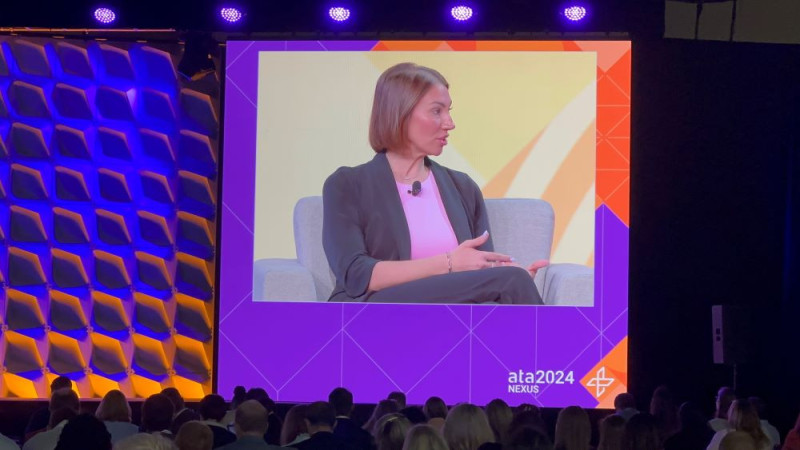
For example, during a Main Stage presentation at ATA, Brandi Clark, OSF OnCall vice president of Digital Care said integrating digital tools that are easy to use can transform the patient experience.
“We are really focused on the end-to-end experience of our patients and the way that our patients experience us from the front end of our website. So, Aniq (from partner Fabric Health) mentioned the AI-driven Chatbot (Clare) that we have at OSF – it’s a great example of the way that technology has changed the experience of the patient and enabled our caregivers to be focused where our patients need them to be.”
Clark says OSF is continually evaluating existing technology partnerships and whether alternatives exist that could provide more value. Collaboration focuses on a select, few partners where there is mutual benefit to helping startups build products using health system data and insights.
Clark emphasized clinical efficiency in telehealth is vital, so pilots prioritize clinician involvement and a regular feedback loop while new technology and workflow are tested. She highlighted digital tools can help clinicians be more efficient and make more informed decisions, but they can’t replace them. Using tools to make providers better at what they do is what Clark calls “the secret sauce.”
Here is more information about OSF OnCall and OSF Innovation.