
Telehealth kiosks connect underserved to local resources
Key Takeaways:
- Heath resource kiosks at four locations in Peoria and three in Chicago are aimed at connecting vulnerable people with health information and connections to community resources
- A findhelp application offers a directory of social and government services by zip code
- Researchers will conduct surveys and interviews with users to get feedback to improve features and functions
Peoria’s Friendship House is a community center that tries to serve everyone in the community. Marcellus Sommerville, chief executive officer, says it’s a safe space and that includes for newly arriving immigrants. It offers after-school programs, English as a Second Language and citizenship classes and it hosts a daily food pantry.
It is also the site of a newly placed telehealth kiosk as part of a continuing grant-funded project through the Community Health Advocacy (CHA) program, a partnership with OSF HealthCare and the University of Illinois Chicago (UIC). The kiosks integrate an iPad with a user-friendly display, which is operated through a touchscreen interface.
The newest version expands an effort that began a couple of years ago. It includes features and functions based on input from OSF HealthCare Faith Community Nurses who provide street medicine to unhoused and vulnerable populations. For example, the kiosks and embedded tablets will use cellular technology, which is important because some areas in vulnerable communities don’t have reliable Wi-Fi.
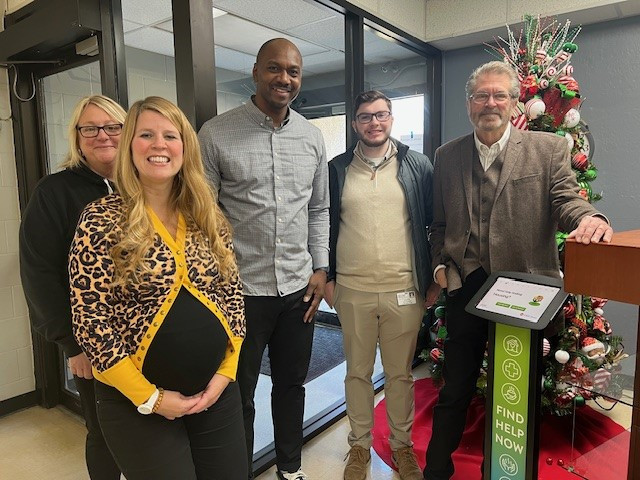 Scott Barrows, MA, director of OSF Innovation Design Lab at Jump Trading Simulation & Education Center in Peoria, says he worked with other OSF Innovation teams including engineering, medical visualization and OSF OnCall to come up with the best design and user-friendly navigation and apps for the kiosks.
“Right now, we have two basic languages – English and Spanish – on the opening page and then other languages in the findhelp portion but it has to be super easy to use. And, that’s another thing we’ll look at.” Barrows explains, “We’ll see how many times does someone have to tap the screen and get to where they want to go? Are they happy with it?”
Findhelp is an application that provides a directory of community-based resources within a pre-selected geographic area. Users can type in a ZIP code and then select what they need. Some of the options address social drivers of health, such as food, housing, work, money, transportation and education. These are things outside of direct medical care that significantly impact a person’s health.
Mary Stapel, MD, lead physician of Community Care at OSF HealthCare Saint Francis Medical Center in Peoria, says current community needs assessments show housing, substance abuse and mental health treatment among the biggest needs. But Stapel says the findhelp app will collect data that could help provide concrete, up-to-date information about what services are most in demand.
Data could drive future services
“I don’t know that we yet fully understand all of the maybe unmet needs that are still apparent for the population that are served here. So again, I think this will help us understand by seeing what people are utilizing on the kiosk.”
Sommerville agrees data collection will help as social service advocates apply for additional grants and government services to improve community health and well-being.
“It could lead to a shift in the community. I always say some programs are created from individuals who feel as though they know what the community needs. This would be the community telling us exactly what they need and now it’s on us to create something specifically for them.” 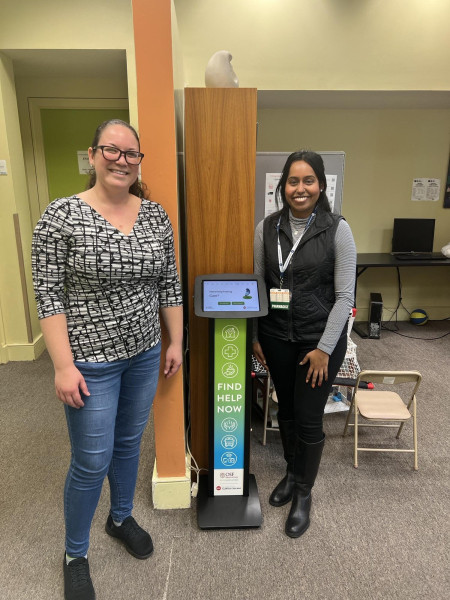
Sommerville is also looking forward to having the findhelp app as a resource for him to tap when someone reaches out looking for help.
“It’ll be nice to be able to say, ‘Hey the Dream Center provides this, or hey CASA provides this, or The Center for Prevention and Abuse provides X’ and to know what I’m talking about when I’m saying it. That’s the part that I appreciate because in the past, it’s always been a phone call or reference of some sort.”
In Peoria, the kiosks will also be located at the Dream Center, the Jolt Foundation and the Peoria City-County Health Department. Barrows says staff at each location will be trained to direct visitors to the kiosks and to help them with navigation if they have issues. However, he says the kiosks should be so user-friendly that they could be used independently. Barrows says research for the next six months to a year will include user feedback.
“We’ll do focus groups. We’ll meet with people one-on-one if they prefer or in small group settings but that is critical in user design. The emphasis is on the people that use it and the resources.”
The same will be occurring in the Chicagoland area where many unhoused Chicagoans also suffer from chronic medical and behavioral health conditions that can make them vulnerable to premature mortality. Under the CHA grant program, kiosks will be located at the Revive Center and Hope’s Table as well as in the outpatient pharmacy at the University of Illinois Chicago.
Faria Munir, PharmD, MS, BCPS is clinical assistant professor of the drug information group at the UIC Retzker College of Pharmacy and is co-lead investigator for the research. She says the secure kiosks will not collect identifying information from users. However, users will be asked if they are willing to fill out follow-up surveys that will include important questions that will inform the second phase of this pilot.
“Like how they're paying for medications. What kind of assistance they need in terms of their health? What kind of are their biggest barriers and receiving both health care and both prescription and OTC (over-the-counter) medications? What kind of concerns do they have about their health? And a lot of questions that are focused on their attitudes toward telehealth.
Down the road, Munir would like to see more health care providers engaged in designing resources that could be available through the kiosks, including potential telehealth visits. But she knows that effort would require bridging a lot of hurdles including protecting user privacy.
In the next phase of the research, Munir does envision expanding the health kiosk locations to more community pharmacies and emergency department waiting rooms. In the meantime, by providing access to information about preventive care, disease management and available quality health care and community resources, researchers from OSF and UIC believe the kiosks can improve individual and community health.