
Tongue-tied
New parents should watch for ankyloglossia and decide if surgery is needed sooner than later
Key takeaways:
- Tongue-tie in newborns occurs when the tissue beneath the tongue is thicker or shorter, restricting the tongue's movement.
- Painful or difficult breastfeeding is another sign of tongue-tie.
- In mild cases, parents may opt to do nothing. In other cases, a provider can snip the tissue. Either way, parents should talk with the care team about a plan sooner than later. Tongue-tie later in life can cause speech and eating issues.
New parents have a long list of things to watch to ensure their child is healthy and developing properly. More observations to add to the list: does the child’s tongue look different? Is breastfeeding difficult? If either answer is yes, the culprit may be ankyloglossia, commonly called tongue-tie.
Sarah Shoemaker, APRN, a certified nurse midwife at OSF HealthCare, says kids may not be affected by the condition depending on the severity, but parents should consult with their health care team on a plan sooner than later.
Shoemaker says tongue-tie occurs when the band of tissue between the bottom of the tongue and the bottom of the mouth (called the frenulum) is thicker, shorter, or covers a large portion of the tongue. This restricts the tongue’s movement. One study published by the National Institutes of Health found that tongue-tie impacts around 8% of newborns, and Shoemaker adds that it impacts boys more than girls. Experts, though, don’t know the exact cause. Shoemaker says it may be genetic (in other words, passed down from prior generations).
Signs of tongue-tie:
- The child’s tongue doesn’t come out of the mouth like it normally would when they stick their tongue out.
- Breastfeeding is painful or difficult. Shoemaker notes, though, that you should rule out other causes of painful breastfeeding, such as ineffective latching or the baby wanting to bite. A lactation consultant can help with this. A pediatric provider can also examine the child’s tongue.
- When your baby cries and lifts their tongue, the tip of the tongue is pulled downward in the shape of a heart.




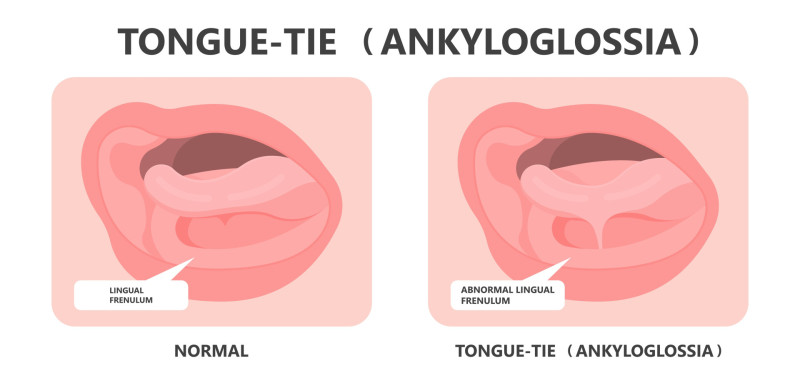
The procedure to fix tongue-tie is pretty simple, Shoemaker says. There’s little blood loss, and it can be done in the hospital, at a pediatrician’s office or at a pediatric dentist’s office.
“They just lift the baby’s tongue and, with sterile scissors, snip [the tissue]. Then, immediately breastfeed [or formula feed if that’s what mom has chosen] because the tongue is free at that point,” Shoemaker explains. “Some providers will teach exercises to do with the baby so [the tissue] doesn’t heal back and have to be snipped again later.” Those exercises involve a parent lifting the tongue.
Some cases of tongue-tie may be mild enough that parents opt to do nothing. In some cases, the frenulum will loosen over time. That approach is fine, Shoemaker says. But the decision should be made with the input of the child’s care team, and it should be made sooner than later. That’s because tongue-tie later in life can cause speech and eating issues, Shoemaker says, and she says the procedure to fix the problem can be more complex when the child is older.
“When done in the newborn period, it’s a very simple procedure done while the baby is awake. If parents choose to wait and see how things go, it might have to be a procedure where the baby or child is put to sleep. So it’s a little bit more involved,” Shoemaker says.
Learn more
Read more about how to have a successful pregnancy, birth and first years of your child’s life on the OSF HealthCare website.
Interview clips
Related stories
Infant nutrition misconceptions
Peeling back the layers